
e-Invoicing UAE
Readiness, Compliance & Implementation
Electronic invoicing in the UAE is changing how businesses issue, exchange, and report invoices, moving from PDFs and email attachments to structured data exchanged through accredited providers. nAlyze helps businesses understand the new requirements, assess system readiness, and prepare for compliance ahead of the applicable deadlines.
Why nAlyze?
- Readiness assessments for UAE digital invoicing
- ERP and invoicing services review
- Guidance on UAE invoicing regulations
- Accredited Service Provider selection support
- Implementation and transition support
Partner with us to prepare for the UAE’s digital invoicing requirements with a clear, practical approach from initial assessment through implementation.
Understanding the UAE's Peppol-based model
The UAE has adopted a Peppol-based 5-corner model to create a secure and standardised framework for exchanging invoice data. Unlike traditional invoicing methods, this model relies on Accredited Service Providers (ASPs) and a centralized reporting mechanism to support transparency and regulatory compliance.
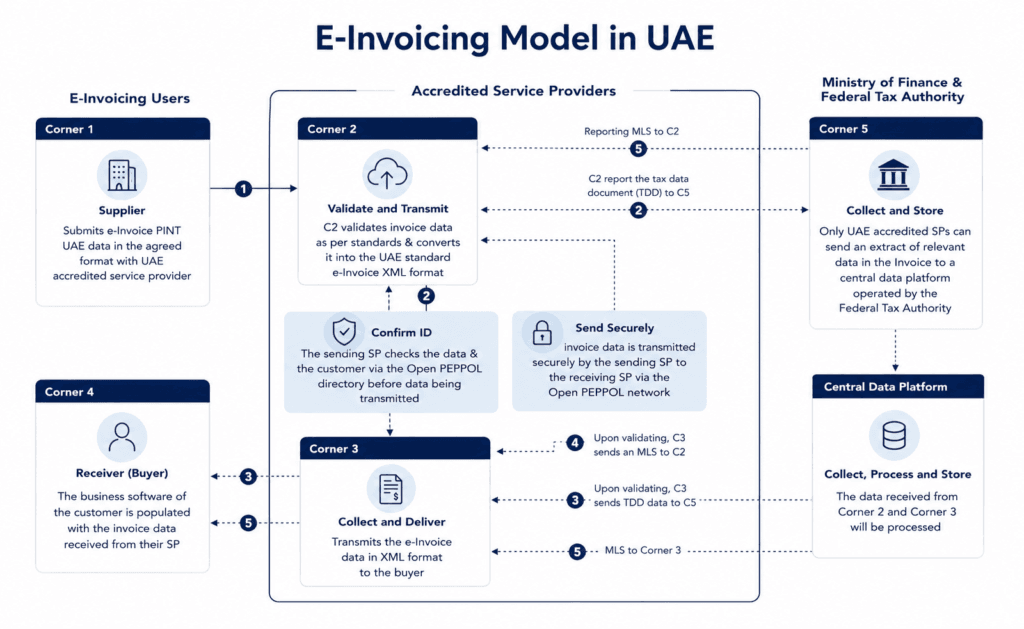
Supplier
The supplier creates and submits a structured electronic invoice through its Accredited Service Provider.
Supplier's Service Provider
The supplier’s Accredited Service Provider validates the invoice, converts it into the required format, and securely transmits it through the Peppol network.
Buyer's Service Provider
The buyer’s Accredited Service Provider receives the invoice and delivers it to the buyer in a format compatible with their systems.
Buyer
The buyer receives the electronic invoice directly within their accounting or ERP system, enabling faster and more efficient processing.
Ministry of Finance & Federal Tax Authority
Relevant transaction data is shared with the Ministry of Finance and the Federal Tax Authority through a centralized platform, helping ensure compliance and supporting digital tax administration.
At nAlyze, we help businesses understand how this framework will affect their existing processes and prepare for a smooth transition to digital invoicing.
What businesses should expect?
The move to electronic invoicing will take place in phases, giving businesses time to assess their systems, update processes, and prepare for the new requirements.
- 2025 Launch of the UAE's e-invoicing framework.
- 2026 Accreditation of service providers and phased preparations.
- 2027 Mandatory implementation begins for businesses and government entities.

Building blocks of UAE e-invoicing
As the UAE moves towards mandatory digital invoicing, businesses will need to align their systems and processes with the new framework. At nAlyze, we help clients understand the requirements, identify gaps, and prepare their operations for a seamless transition.
Structured E-Invoices
Invoices must follow the UAE’s prescribed format.
System Integrations
ERP and accounting systems may require connectivity with service providers.
Digital Archiving
Electronic invoices must be securely retained for the required period.
Accredited Service Providers
Only approved providers can validate and transmit invoices.
B2B & B2G Transactions
The framework applies to both business and government transactions.
Cross-Border Reporting
Certain international transactions will also require reporting.
How nAlyze helps you prepare?
Such invoicing compliance requires more than a software upgrade. We work alongside businesses to map existing invoicing processes, identify the gaps between where they are and what the framework requires, and support them through implementation.
Assessing Readiness
We begin by understanding your current invoicing and reporting processes.
Reviewing Systems
Identifying Gaps
Supporting Implementation
Start your e invoicing UAE readiness assessment
The move to electronic invoicing is more than a compliance exercise. Let nAlyze help your business prepare for the transition with clarity and confidence.
Frequently Asked Questions
What is e-invoicing?
E-invoicing is the electronic exchange of invoices in a structured format, allowing businesses to issue, receive, and process invoices digitally.
Will e-invoicing become mandatory in the UAE?
Yes. The UAE is introducing e-invoicing in phases, with implementation expected to take place over the coming years.
What is the Peppol-based five-corner model?
The five-corner model is a decentralized framework that enables businesses to exchange invoices through accredited service providers while ensuring secure and standardized communication.
Which businesses will be affected by e-invoicing?
The framework is expected to apply to B2B and B2G transactions, affecting businesses across industries.
Will businesses need to upgrade their ERP systems?
Depending on the existing setup, some businesses may need to review or enhance their systems to ensure compatibility with the new framework.
What are Accredited Service Providers (ASPs)?
ASPs are approved entities responsible for validating and transmitting electronic invoices within the UAE’s e-invoicing ecosystem.
How can nAlyze help businesses prepare for e-invoicing?
At nAlyze, we help businesses assess readiness, review processes, identify gaps, and support the transition as the UAE’s e-invoicing framework continues to evolve.
When does e-invoicing become mandatory in the UAE?
Implementation is phased, with mandatory adoption applying to businesses and government entities in the final stage. Specific dates are set by the Ministry of Finance and have been refined since the framework was announced – we confirm the current position and what it means for your entity.
What do I need to do to reach e-invoicing compliance?
At minimum: confirm your invoicing system can produce the required structured format, connect to an Accredited Service Provider, clean up customer and supplier master data, and set up compliant electronic archiving.
Will my current accounting software work with e-invoicing?
It depends on the platform and version. Major cloud accounting systems are building integration; older or heavily customised systems may need upgrade or middleware. The system review establishes this early, while there is still time to act on the answer.
What happens if an invoice fails validation?
A structured invoice that does not meet the required format is rejected by the service provider before transmission. In practice this means invoicing errors surface immediately rather than at period end – which is an argument for getting master data right before the mandate applies.
